“A place to live, not a place to die”
When Adam first heard the word hospice, he had negative preconceptions and wasn’t sure about what to expect. But what Adam experienced, changed his entire outlook on not only hospice care, but his life.
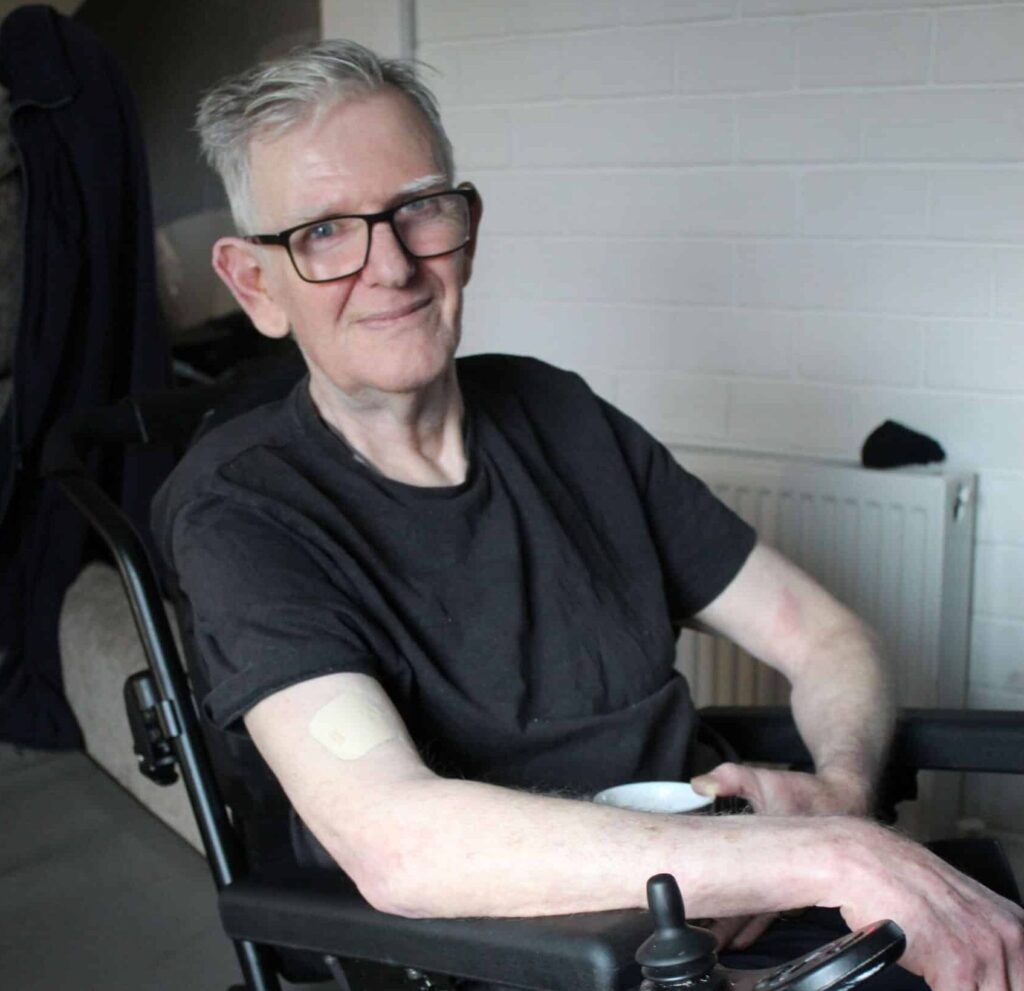
Following a diagnosis of Parkinson’s disease, Adam thought he had plenty of time to enjoy life, without interference with the disease that would come later. But after a rapid progression of onset symptoms, Adam was re-diagnosed with MSA, Multiple System Atrophy – a rapidly progressive neurological condition.
“I’d gone from being able-bodied and walking miles in the countryside to being in a wheelchair”, he explained, “You don’t realise how isolating illness can be until you’re in it.”
Adam found himself increasingly cut off from everyday life, with his diagnosis taking a significant toll on his independence and mobility – leaving him feeling isolated. “I didn’t see a lot of people, and I wasn’t integrating.’
Adam’s Neuro Physiotherapist encouraged him to try the Living Well programme at Eden Valley Hospice and Jigsaw.
“I had the usual preconception – that the hospice was where people went to die. He said, “But I trusted her. And it turns out she was right”.
From the moment Adam arrived, everything he thought he knew about hospices changed. “I soon found out it wasn’t a place where you go to die – it’s a place where you go to live,” he said.
Adam described the hospice as the first place in a long time where he felt he could take a breath without worrying, “I’ve got breathing apparatus, special chairs, special beds, special everything,” he explained. “It makes it really difficult to get up and do anything.”
Adam described the hospice as the one place where the burden of his illness felt lighter, “in the hospice environment, you can feel safe. You can forget your disability for a period of time and feel normal and supported. That is such a benefit to somebody like me.”
The hospice gave Adam a break from the isolation of his illness. The warm smiles from staff, and the gentle reassurance that his illness didn’t define him. He found connection again, describing the experience as cathartic – something that stayed with him for days afterwards. “It gives you something to look forward to. When you’re stimulated, it goes beyond the days. It sustains you.”
For Adam, the hospice wasn’t a medical facility. It became a place where, since his diagnosis, he felt truly seen. At a time in his life when his illness had made him feel invisible, “people look over you, not at you, when you’re in a wheelchair”, but the hospice became a place where he felt valued again.
A moment that stayed with him was receiving a hug from one of the therapists – Adam described it as an unexpected, disarming act that opened something inside him that illness had quietly closed-down. “I’m not a touchy-feely person” he admitted, “but she made me comfortable with it. It opened a door in me I didn’t even know was closed.” In that moment, it felt like the weight Adam had been carrying eased just a little.
What struck Adam most was the mindset of the hospice, “it lets you live without constraint, even just for a while.”
Living with MSA, Adam has had to face difficult questions about what his end-of-life care looks like. Adam describes how the hospice helped him rethink how he views dying. He now sees it as something that can be approached with peace, and dignity, and that it doesn’t have to be daunting. “Once I was scared, I used to be obsessed with dying; now I’m obsessed with living. That is the best thing I’ve got from the hospice.”
For Adam, the hospice has helped remove the fear of what comes next. “I always thought I wanted to die at home. But now, knowing what I know, I’d be happy to spend my last days at the hospice. I wouldn’t want my family to carry that responsibility.”
Hospice care, for Adam, means that his family doesn’t have to worry. It means that when the time comes, he will be surrounded by the people who love him, without the stress of managing end-of-life care at home. “The hospice made me realise I can choose the way I die. I can make it loving.”
Knowing that his approach to end-of-life care can be shaped around the care he wants, has allowed him to focus on living, and despite his condition, Adam wants to encourage others to access hospice care, without fear and misconceptions, “you don’t go there to die. You go there to live – to live what you’ve got, to the best of your ability.”
He is continuing to advocate for hospice care in any way he can “If I can help one person feel less isolated or scared, it’s worth it. That’s what we all want. In the end. We all want to feel wanted.”